 Add to Chrome
 Add to Firefox
 Add to Edge
Distinguishing Right from Wrong in Debates: Attribution Analysis of Chinese Harmful Memes
May 23, 2026
Research on harmful meme detection has garnered significant attention, resulting in the development of numerous datasets and methods. However, progress in detecting Chinese harmful memes lags considerably, primarily due to two challenges: first, accurately assessing a meme's harmfulness depends heavily on understanding deep cultural context; second, many memes are semantically ambiguous, making harmfulness highly subjective. To address these issues, we focus on the interpretable detection of Chinese harmful memes by constructing the first Chinese harmful meme explanation dataset, Ex-ToxiCN-MM. This dataset offers opposing interpretations, categorized as "harmful" and "non-harmful", for each meme, aiming to rigorously evaluate a model's ability to discern and comprehend ambiguous, culturally grounded content. We built a specialized knowledge base of Chinese cultural concepts and offensive vocabulary to supply models with essential prior knowledge (C-HarmKB). To address the ambiguity and lack of background knowledge in meme attribution, we have developed a comprehensive attribution analysis framework, RIKE, which includes an Attribution Knowledge Enhancement module (AKE) and a Relative Intent Reasoning module (RIR). Extensive quantitative and qualitative experiments demonstrate that our method outperforms mainstream baseline models across multiple metrics in the task of attributing harmful memes in Chinese. The code, Ex-ToxiCN-MM dataset, and Chinese Harmful Semantic Knowledge Base (C-HarmKB) involved in this study have been open-sourced at https://github.com/wimiw123/Ex-ToxiCN-MM

Harder to Defend: Towards Chinese Toxicity Attacks via Implicit Enhancement and Obfuscation Rewriting
May 21, 2026Large language models (LLMs) require robust toxicity evaluation beyond explicit wording. This setting remains underexplored in Chinese, where toxicity may combine semantic indirectness with surface obfuscation. We introduce Chinese Implicit Toxicity Attack (CITA), a controlled red-team evaluation and defense-data generation framework, not a deployable evasion tool. CITA uses three stages: (i) Harmful Intent Learning, (ii) Implicit Toxicity Enhancement, and (iii) Obfuscation Variant Rewriting, to preserve harmful intent, increase implicitness, and add controlled surface variants. On CITA-generated evaluation samples, the seven tested detectors exhibit substantial missed-detection risks, reaching an average ASR of 69.48%; human evaluation further confirms preserved harmfulness and increased implicitness/evasiveness. As a downstream defense application, we fine-tune a Chinese Implicit Toxicity Defense model (CITD) with CITA-generated red-team data, showing that such data can improve robustness through additional training.
Aligning LLM Uncertainty with Human Disagreement in Subjectivity Analysis
May 11, 2026Large language models for subjectivity analysis are typically trained with aggregated labels, which compress variations in human judgment into a single supervision signal. This paradigm overlooks the intrinsic uncertainty of low-agreement samples and often induces overconfident predictions, undermining reliability and generalization in complex subjective settings. In this work, we advocate uncertainty-aware subjectivity analysis, where models are expected to make predictions while expressing uncertainty that reflects human disagreement. To operationalize this perspective, we propose a two-phase Disagreement Perception and Uncertainty Alignment (DPUA) framework. Specifically, DPUA jointly models label prediction, rationale generation, and uncertainty expression under an uncertainty-aware setting. In the disagreement perception phase, adaptive decoupled learning enhances the model's sensitivity to disagreement-related cues while preserving task performance. In the uncertainty alignment phase, GRPO-based reward optimization further improves uncertainty-aware reasoning and aligns the model's confidence expression with the human disagreement distribution. Experiments on three subjectivity analysis tasks show that DPUA preserves task performance while better aligning model uncertainty with human disagreement, mitigating overconfidence on boundary samples, and improving out-of-distribution generalization.
RexDrug: Reliable Multi-Drug Combination Extraction through Reasoning-Enhanced LLMs
Mar 09, 2026Automated Drug Combination Extraction (DCE) from large-scale biomedical literature is crucial for advancing precision medicine and pharmacological research. However, existing relation extraction methods primarily focus on binary interactions and struggle to model variable-length n-ary drug combinations, where complex compatibility logic and distributed evidence need to be considered. To address these limitations, we propose RexDrug, an end-to-end reasoning-enhanced relation extraction framework for n-ary drug combination extraction based on large language models. RexDrug adopts a two-stage training strategy. First, a multi-agent collaborative mechanism is utilized to automatically generate high-quality expert-like reasoning traces for supervised fine-tuning. Second, reinforcement learning with a multi-dimensional reward function specifically tailored for DCE is applied to further refine reasoning quality and extraction accuracy. Extensive experiments on the DrugComb dataset show that RexDrug consistently outperforms state-of-the-art baselines for n-ary extraction. Additional evaluation on the DDI13 corpus confirms its generalizability to binary drugdrug interaction tasks. Human expert assessment and automatic reasoning metrics further indicates that RexDrug produces coherent medical reasoning while accurately identifying complex therapeutic regimens. These results establish RexDrug as a scalable and reliable solution for complex biomedical relation extraction from unstructured text. The source code and data are available at https://github.com/DUTIR-BioNLP/RexDrug
Propagating Similarity, Mitigating Uncertainty: Similarity Propagation-enhanced Uncertainty for Multimodal Recommendation
Jan 27, 2026Multimodal Recommendation (MMR) systems are crucial for modern platforms but are often hampered by inherent noise and uncertainty in modal features, such as blurry images, diverse visual appearances, or ambiguous text. Existing methods often overlook this modality-specific uncertainty, leading to ineffective feature fusion. Furthermore, they fail to leverage rich similarity patterns among users and items to refine representations and their corresponding uncertainty estimates. To address these challenges, we propose a novel framework, Similarity Propagation-enhanced Uncertainty for Multimodal Recommendation (SPUMR). SPUMR explicitly models and mitigates uncertainty by first constructing the Modality Similarity Graph and the Collaborative Similarity Graph to refine representations from both content and behavioral perspectives. The Uncertainty-aware Preference Aggregation module then adaptively fuses the refined multimodal features, assigning greater weight to more reliable modalities. Extensive experiments on three benchmark datasets demonstrate that SPUMR achieves significant improvements over existing leading methods.
The Straight and Narrow: Do LLMs Possess an Internal Moral Path?
Jan 15, 2026Enhancing the moral alignment of Large Language Models (LLMs) is a critical challenge in AI safety. Current alignment techniques often act as superficial guardrails, leaving the intrinsic moral representations of LLMs largely untouched. In this paper, we bridge this gap by leveraging Moral Foundations Theory (MFT) to map and manipulate the fine-grained moral landscape of LLMs. Through cross-lingual linear probing, we validate the shared nature of moral representations in middle layers and uncover a shared yet different moral subspace between English and Chinese. Building upon this, we extract steerable Moral Vectors and successfully validate their efficacy at both internal and behavioral levels. Leveraging the high generalizability of morality, we propose Adaptive Moral Fusion (AMF), a dynamic inference-time intervention that synergizes probe detection with vector injection to tackle the safety-helpfulness trade-off. Empirical results confirm that our approach acts as a targeted intrinsic defense, effectively reducing incorrect refusals on benign queries while minimizing jailbreak success rates compared to standard baselines.
Overview of CHIP 2025 Shared Task 2: Discharge Medication Recommendation for Metabolic Diseases Based on Chinese Electronic Health Records
Nov 09, 2025Discharge medication recommendation plays a critical role in ensuring treatment continuity, preventing readmission, and improving long-term management for patients with chronic metabolic diseases. This paper present an overview of the CHIP 2025 Shared Task 2 competition, which aimed to develop state-of-the-art approaches for automatically recommending appro-priate discharge medications using real-world Chinese EHR data. For this task, we constructed CDrugRed, a high-quality dataset consisting of 5,894 de-identified hospitalization records from 3,190 patients in China. This task is challenging due to multi-label nature of medication recommendation, het-erogeneous clinical text, and patient-specific variability in treatment plans. A total of 526 teams registered, with 167 and 95 teams submitting valid results to the Phase A and Phase B leaderboards, respectively. The top-performing team achieved the highest overall performance on the final test set, with a Jaccard score of 0.5102, F1 score of 0.6267, demonstrating the potential of advanced large language model (LLM)-based ensemble systems. These re-sults highlight both the promise and remaining challenges of applying LLMs to medication recommendation in Chinese EHRs. The post-evaluation phase remains open at https://tianchi.aliyun.com/competition/entrance/532411/.
MedTrust-RAG: Evidence Verification and Trust Alignment for Biomedical Question Answering
Oct 16, 2025Biomedical question answering (QA) requires accurate interpretation of complex medical knowledge. Large language models (LLMs) have shown promising capabilities in this domain, with retrieval-augmented generation (RAG) systems enhancing performance by incorporating external medical literature. However, RAG-based approaches in biomedical QA suffer from hallucinations due to post-retrieval noise and insufficient verification of retrieved evidence, undermining response reliability. We propose MedTrust-Guided Iterative RAG, a framework designed to enhance factual consistency and mitigate hallucinations in medical QA. Our method introduces three key innovations. First, it enforces citation-aware reasoning by requiring all generated content to be explicitly grounded in retrieved medical documents, with structured Negative Knowledge Assertions used when evidence is insufficient. Second, it employs an iterative retrieval-verification process, where a verification agent assesses evidence adequacy and refines queries through Medical Gap Analysis until reliable information is obtained. Third, it integrates the MedTrust-Align Module (MTAM) that combines verified positive examples with hallucination-aware negative samples, leveraging Direct Preference Optimization to reinforce citation-grounded reasoning while penalizing hallucination-prone response patterns. Experiments on MedMCQA, MedQA, and MMLU-Med demonstrate that our approach consistently outperforms competitive baselines across multiple model architectures, achieving the best average accuracy with gains of 2.7% for LLaMA3.1-8B-Instruct and 2.4% for Qwen3-8B.
FocusMed: A Large Language Model-based Framework for Enhancing Medical Question Summarization with Focus Identification
Oct 06, 2025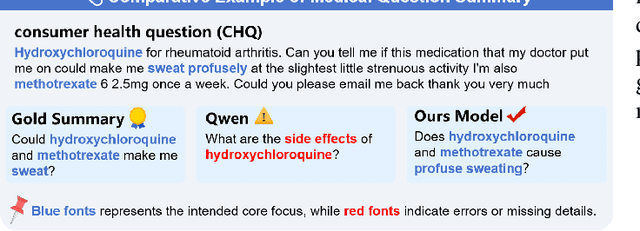
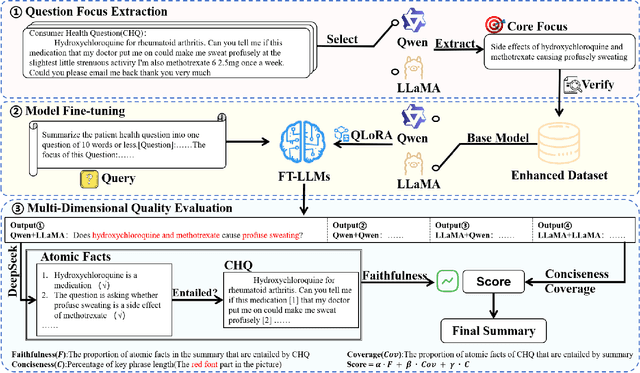
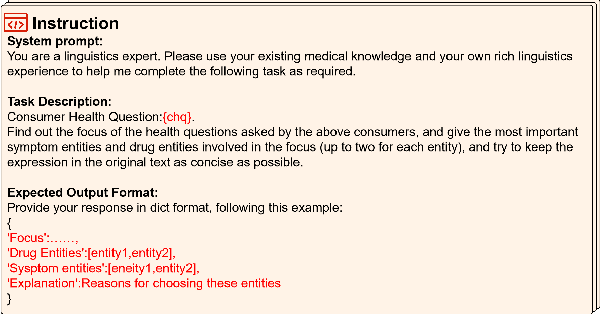
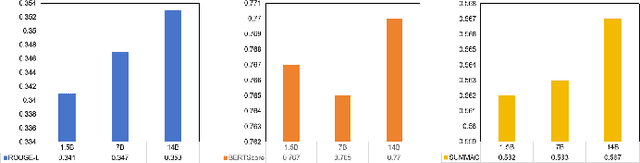
With the rapid development of online medical platforms, consumer health questions (CHQs) are inefficient in diagnosis due to redundant information and frequent non-professional terms. The medical question summary (MQS) task aims to transform CHQs into streamlined doctors' frequently asked questions (FAQs), but existing methods still face challenges such as poor identification of question focus and model hallucination. This paper explores the potential of large language models (LLMs) in the MQS task and finds that direct fine-tuning is prone to focus identification bias and generates unfaithful content. To this end, we propose an optimization framework based on core focus guidance. First, a prompt template is designed to drive the LLMs to extract the core focus from the CHQs that is faithful to the original text. Then, a fine-tuning dataset is constructed in combination with the original CHQ-FAQ pairs to improve the ability to identify the focus of the question. Finally, a multi-dimensional quality evaluation and selection mechanism is proposed to comprehensively improve the quality of the summary from multiple dimensions. We conduct comprehensive experiments on two widely-adopted MQS datasets using three established evaluation metrics. The proposed framework achieves state-of-the-art performance across all measures, demonstrating a significant boost in the model's ability to identify critical focus of questions and a notable mitigation of hallucinations. The source codes are freely available at https://github.com/DUT-LiuChao/FocusMed.
CommonVoice-SpeechRE and RPG-MoGe: Advancing Speech Relation Extraction with a New Dataset and Multi-Order Generative Framework
Sep 10, 2025Speech Relation Extraction (SpeechRE) aims to extract relation triplets directly from speech. However, existing benchmark datasets rely heavily on synthetic data, lacking sufficient quantity and diversity of real human speech. Moreover, existing models also suffer from rigid single-order generation templates and weak semantic alignment, substantially limiting their performance. To address these challenges, we introduce CommonVoice-SpeechRE, a large-scale dataset comprising nearly 20,000 real-human speech samples from diverse speakers, establishing a new benchmark for SpeechRE research. Furthermore, we propose the Relation Prompt-Guided Multi-Order Generative Ensemble (RPG-MoGe), a novel framework that features: (1) a multi-order triplet generation ensemble strategy, leveraging data diversity through diverse element orders during both training and inference, and (2) CNN-based latent relation prediction heads that generate explicit relation prompts to guide cross-modal alignment and accurate triplet generation. Experiments show our approach outperforms state-of-the-art methods, providing both a benchmark dataset and an effective solution for real-world SpeechRE. The source code and dataset are publicly available at https://github.com/NingJinzhong/SpeechRE_RPG_MoGe.